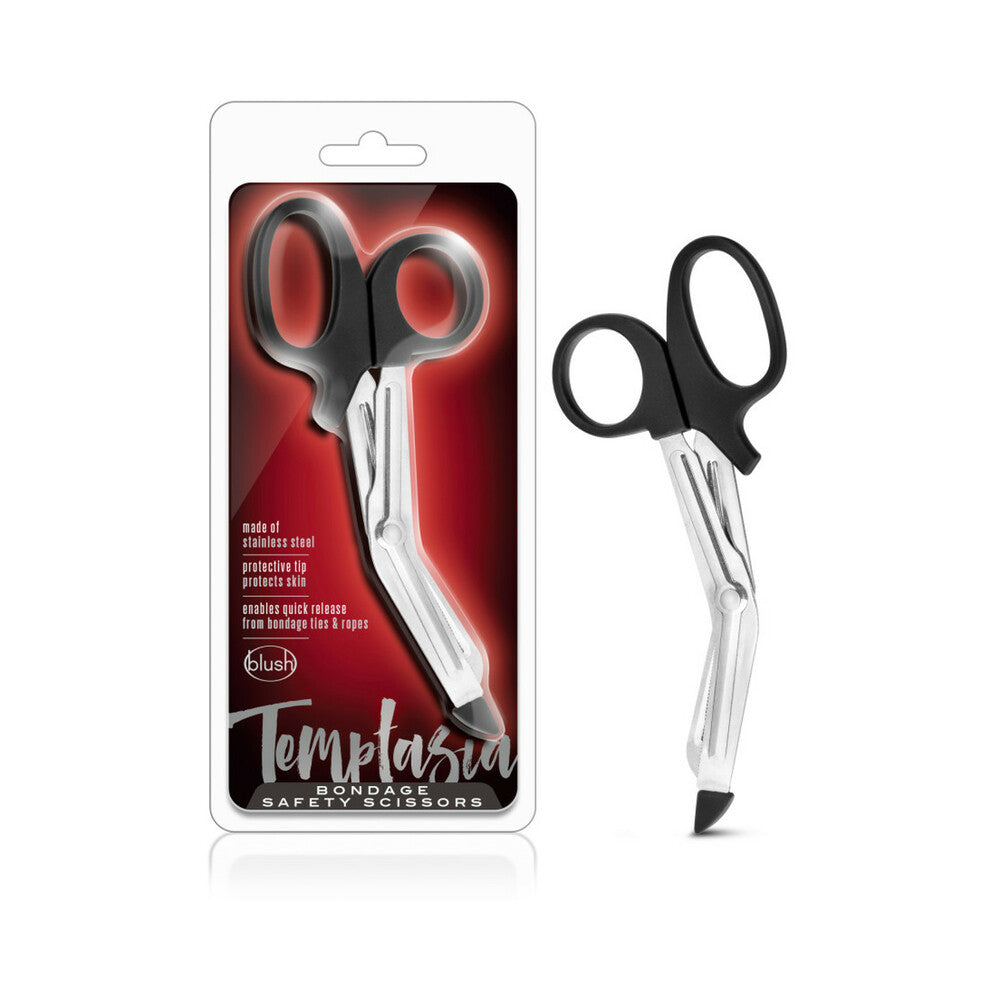
Temptasia Bondage Safety Scissors are black-handled stainless-steel utility shears intended to help cut rope, bondage tape, poly wrap, zip ties, clothing, and other soft restraint materials when a person needs to be released. The angled handle and rounded protected tip are designed to improve access and reduce direct contact between the blade tip and skin. They do not make cutting near a body risk-free, and they are not a substitute for quick-release restraints, attentive supervision, or emergency services.
Keep release tools within immediate reach whenever restraint materials cannot be opened instantly by hand. Compare related equipment in Kink and Restraint, browse the broader Kink, Couples, and Advanced Play department, or read How to Start With Bondage Restraints before building a first safety plan.
Verified product facts
- Store SKU: NAL-67641
- Supplier item: 67641
- Manufacturer number: BL-41699
- UPC: 819835022640
- Brand and collection: Blush Temptasia
- Color: black
- Blade material: stainless steel
- Listed size: 6.5 inches long by 2.5 inches wide / 16.5 by 6.4 cm
- Design: angled handle with a rounded protected tip
- Power: manual
- Water resistance: supplier lists the product as not water resistant
The supplier describes these scissors as lightweight, easy to use, and easy to clean, and identifies rope, tape, poly wrap, zip ties, soft bondage materials, and clothing as intended cutting examples. Those statements do not guarantee that the scissors will cut every material, thickness, knot, seam, buckle, cable, chain, reinforced strap, or zip tie. Test the exact restraint material off the body before relying on the scissors in a session.
Build release into the restraint plan
Safety scissors are a backup, not the only release method. Prefer restraints with a quick-release buckle, release lever, loose working end, accessible knot, or another method that can be opened without bringing a blade near skin. If a restraint must be cut, know in advance which section creates the safest access and which direction lets the material fall away from the body.
For partnered play, agree on informed adult consent, limits, circulation checks, stop words or signals, and the release procedure before applying restraints. Keep the scissors visible and reachable by the person responsible for release; do not leave them across the room, inside a locked drawer, under other equipment, or in a bag that cannot be opened quickly. Our guide to using sex toys with a partner provides a practical framework for communication and check-ins.
Never leave a restrained person unattended. Do not restrain anyone who is asleep, intoxicated, sedated, unable to communicate, or unable to consent. Avoid positions that restrict breathing, place pressure on the neck, compress a joint, suspend body weight without specialized training, or delay circulation and sensation checks.
Inspect and rehearse before play
- Inspect both handles, the hinge, screw or pivot, blades, cutting edges, rounded protected tip, finish, and alignment. Do not use the scissors if any part is loose, bent, chipped, cracked, corroded, sticky, contaminated, or difficult to operate.
- Open and close the scissors repeatedly off the body. The blades should move smoothly without unexpected sticking or excessive side-to-side movement.
- Test on a spare piece of the exact rope, tape, wrap, clothing, or zip tie planned for the session. Use the same number of layers and approximate tension.
- Confirm where the scissors will be kept and who will retrieve them. A second release method should remain available when practical.
- Rehearse the hand position and cutting direction without a person restrained. The protected tip should face the body and remain between skin and the cutting edge only when there is enough safe clearance.
If the scissors fail the off-body test, choose another restraint or a more appropriate release tool. Do not assume greater force will solve the problem safely. Thick rope, hardened plastic, wire, metal, chains, reinforced webbing, or multiple compressed layers may require tools these scissors were not designed to handle.
Conservative emergency-release technique
- Stop all movement and tell the restrained person what you are doing. If there is an immediate threat to breathing, circulation, consciousness, or life, call emergency services while beginning the safest available release.
- Stabilize the restrained area without adding pressure. Create visible space between material and skin whenever possible.
- Slide the rounded protected tip under the restraint only when you can see or feel a clear path and keep the protected surface against the body. Never push blindly under a tight restraint.
- Cut away from skin, sensitive anatomy, hair, piercings, medical devices, and the face. Use short, controlled cuts instead of pulling or twisting the material toward the body.
- Support the loose end so a cut restraint does not snap, recoil, tighten elsewhere, or strike the person.
- Remove all remaining material, inspect the skin and circulation, and stop the session. Do not immediately reapply restraint over an injured, numb, swollen, or discolored area.
A rounded tip reduces one hazard but does not prevent cuts, pinches, punctures, friction, or injury from a blade edge, hinge, sudden movement, or tight material. Do not insert the scissors under a restraint when there is no clearance. Do not cut toward the neck, genitals, eyes, or major blood vessels. If safe access is impossible, get professional emergency help rather than improvising with force.
Warning signs that require immediate release
Release restraints promptly for pain, numbness, tingling, cold skin, swelling, loss of sensation, weakness, dizziness, shortness of breath, panic, unusual color change, bleeding, broken skin, or inability to communicate. If the restrained person becomes unresponsive, has trouble breathing, has severe swelling or discoloration, loses circulation or sensation, or has symptoms that persist after release, call emergency services.
Safety scissors are not medical instruments and do not provide medical treatment. After an emergency cut, assess whether injury occurred. When in doubt, seek appropriate medical care rather than resuming the scene.
Storage and access
Store the scissors closed, clean, dry, and protected from corrosion, but not so securely that they are unavailable during use. Keep them away from children and anyone who may handle sharp tools unsafely. Avoid burying them under equipment or leaving them where the handles can catch, the hinge can be contaminated, or the blades can be damaged.
If more than one play area is used, place a verified release tool in each area rather than moving one pair and assuming it arrived. Check the location before every session. Keep ordinary scissors, knives, box cutters, and improvised blades out of the emergency plan when they lack a protected tip or controlled angle.
Cleaning and care
The supplier identifies stainless steel and lists the product as not water resistant. Wipe and clean only as the physical product instructions allow, then dry the blades, hinge, protected tip, and handles completely. Do not soak, submerge, boil, dishwash, autoclave, bleach, or lubricate the pivot unless the current manufacturer instructions expressly permit the method.
Inspect after cleaning for moisture, residue, rust, roughness, blade damage, looseness, or misalignment. Replace the scissors if they no longer open, close, or cut representative material predictably. General storage and material-care guidance is available in Materials and Care, but the physical instructions for this tool control.
Before opening the package
Verify the Temptasia name, black color, UPC 819835022640, manufacturer number BL-41699, visible condition, and included product before opening. If the wrong item arrived, packaging is damaged, the protected tip is deformed, or a component is missing, do not clean, test, cut, or use it. Preserve the packaging and contact us. Review our returns, refunds, and hygiene policy before opening when eligibility matters.
Orders use discreet shipping. For questions about product identity, the visible packaging, or the current instructions, contact The Stag Standard. Browse Gear and Apparel, visit the Learn library, or return to the full shop for related equipment and guidance.